
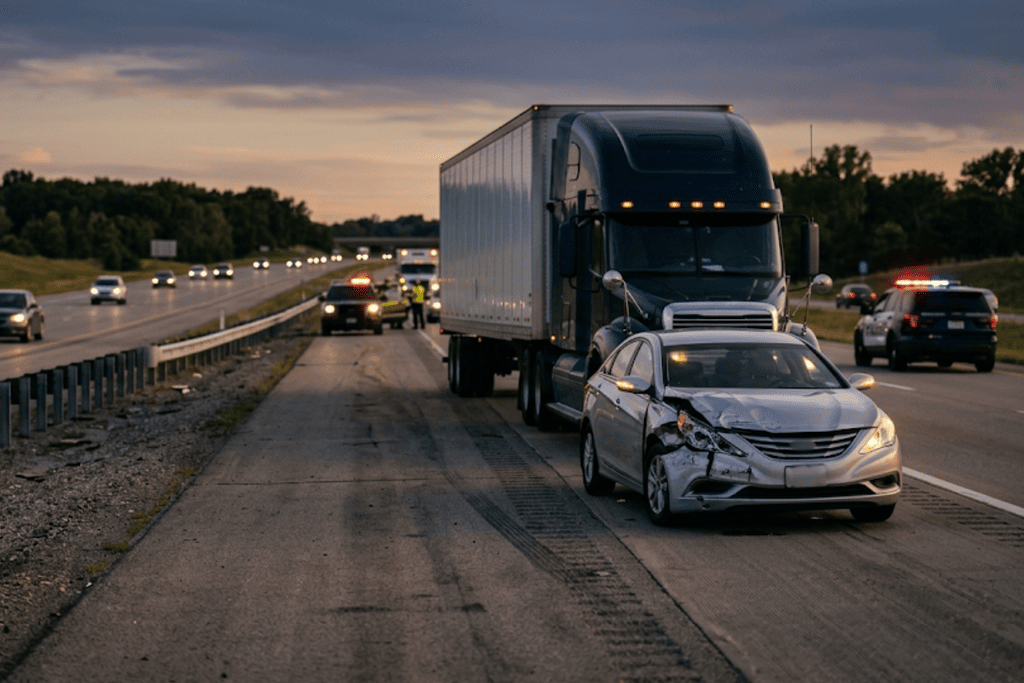
Interstate 44 carries a steady stream of semi-trucks through Tulsa every day, linking freight yards in Oklahoma City to distribution hubs in Joplin and beyond, and that same corridor runs directly past neighborhoods, shopping centers, and daily commuters. When one of those 80,000-pound rigs collides with a passenger car, the aftermath rarely feels like an ordinary fender-bender. Medical bills climb fast, the vehicle is often a total loss, and the first real question most victims type into their phone from a hospital bed or a tow yard is some version of semi truck hit my car who do I sue the driver or company. The honest answer is that both may be responsible, and figuring out exactly who owes what depends on a set of facts unique to trucking cases that do not apply to ordinary car accidents.
Unlike a crash between two private drivers, a semi-truck wreck almost always involves a commercial operation with its own insurance policy, its own safety obligations under federal law, and its own financial incentive to limit what it pays out. That combination is why trucking claims tend to move differently than standard Tulsa, Oklahoma car accident cases, and why identifying every party who contributed to the crash matters so much to the outcome.
The Truck Driver’s Own Negligence
The driver is usually the first name attached to a truck accident claim, and for good reason. If the driver was speeding, following too closely, driving while fatigued, texting, or ran a red light, that conduct is ordinary negligence, the same legal theory that applies to any driver who fails to operate a vehicle safely. Fatigue is a particular concern in trucking because drivers are paid to keep freight moving, and the temptation to push past federal hours-of-service limits is well documented. The hours of service rules set specific driving and rest limits for commercial drivers precisely because fatigue behind the wheel of a truck is so dangerous.
The Trucking Company’s Liability
Here is where trucking cases diverge sharply from a typical two-car accident. Under a legal doctrine called vicarious liability, or respondeat superior, an employer can be held responsible for the negligent acts of an employee committed within the scope of the job. In practice, that means if the truck driver was on duty, hauling a load for the company, the trucking or motor carrier company can usually be sued right alongside the driver, even if company management never touched the wheel.
The trucking company can also be independently at fault, separate from anything the driver did. If the company hired a driver with a poor safety record, skipped required background checks, failed to train the driver properly, or pushed unrealistic delivery schedules that encouraged speeding, that is negligent hiring or negligent supervision, a direct claim against the company itself. The same is true if the company let a truck run with worn brakes, bald tires, or a known mechanical defect. Federal regulators have documented for years how large truck and bus crashes are tracked and analyzed precisely because carrier-level decisions, not just driver behavior, so often factor into the outcome. Industry safety compliance data even shows measurable differences in crash rates between carriers that actively monitor safety practices and those that do not, underscoring how much a company’s internal standards matter.
Semi Truck Hit My Car, Who Do I Sue? Other Parties Worth Investigating
The driver and the trucking company are not always the full story. A thorough investigation into a Tulsa truck accident often turns up other potentially responsible parties, including:
- A cargo loading company that improperly loaded or secured freight, causing the trailer to shift, roll, or spill its load
- A maintenance contractor hired to service the truck who missed a defect that later caused a brake or tire failure
- A truck or parts manufacturer whose defective brakes, tires, steering components, or coupling system contributed to the crash
- A leasing company or owner-operator arrangement where the truck and driver are technically separate businesses from the carrier
- A freight broker who selected an unsafe carrier despite red flags in its safety record
Because commercial trucks carry heavier loads and sit higher off the ground than passenger vehicles, the physics of a collision are also different. Research into truck crashworthiness shows how the size and weight disparity between a semi and a car changes both the severity of injuries and the number of parties whose equipment or cargo may have played a role.
Who Can Be Held Liable in a Semi-Truck Accident
| Potentially Liable Party | Typical Legal Basis | Why They May Be Responsible |
|---|---|---|
| Truck Driver | Negligence | Speeding, fatigue, distraction, or other unsafe driving behavior |
| Trucking/Motor Carrier Company | Vicarious liability (respondeat superior) and negligent hiring | Employer of the driver on duty; may have hired, trained, or supervised poorly |
| Cargo Loading Company | Negligence | Improperly loaded or secured freight causing a shift, rollover, or spill |
| Truck/Parts Manufacturer | Product liability/defect | Defective brakes, tires, steering, or coupling components |
| Maintenance Contractor | Negligent maintenance | Missed or improperly performed repairs that later caused a failure |
As the table shows, the truck driver typically answers for ordinary negligence behind the wheel, the trucking company usually answers for the driver’s actions through vicarious liability and for its own hiring or supervision failures, a cargo loader answers for how freight was secured, a manufacturer answers under product liability for a defective part, and a maintenance contractor answers for negligent upkeep of the vehicle. More than one of these parties can share fault in the same crash.
How Investigators Decide Who Pays
Sorting out fault after a semi truck hit my car who do I sue the driver or company situation usually comes down to evidence, not guesswork. Commercial trucks are required to carry certain records that private vehicles are not, and those records often tell the real story of what happened. Driver logs, electronic logging device data, dispatch records, pre-trip inspection reports, maintenance histories, and the carrier’s own safety compliance record with federal regulators can all point toward the driver, the company, or both. Industry data on driver behavior patterns shows that prior violations and unsafe habits tend to repeat, which is one reason carrier hiring and monitoring practices come under such close scrutiny after a crash. Knowing what evidence to gather early, before records are lost or destroyed, can shape the entire direction of a claim.
Trucking companies also carry commercial insurance policies with limits far higher than a typical personal auto policy, and their insurers send trained adjusters and sometimes rapid-response investigation teams to the scene within hours of a serious crash. That is a very different playing field than a routine claim between two private drivers, and it is one reason so many Tulsa accident victims want a clear answer before they say anything to an insurance adjuster. If a commercial vehicle was involved in your crash, it is worth a free consultation before you accept any settlement offer or sign anything from the carrier’s insurer.
Why Choose Truskett Law
Trucking claims are rarely simple because they are rarely two-party disputes. Sorting through which combination of the driver, the motor carrier, a cargo loader, a parts manufacturer, or a maintenance contractor bears responsibility takes a working knowledge of the Federal Motor Carrier Safety Regulations that govern commercial trucking, not just general accident law. Truskett Law approaches every truck accident claim by pulling the same records regulators use, driver qualification files, hours-of-service logs, maintenance and inspection reports, and the carrier’s safety history, to see exactly where the breakdown happened.
Corporate carriers and their insurers move fast after a wreck, often dispatching investigators before the wreckage is even cleared, because early statements and quickly settled claims tend to favor the company. Truskett Law works from the same urgency in the other direction, preserving evidence, identifying every party who may share liability, and pushing back on insurers who try to shift blame solely onto the driver to shield the carrier from a larger vicarious liability claim. That approach reflects years of focus specifically on Oklahoma trucking wrecks, not personal injury cases in general, and it shapes how each claim is built from the first phone call.
Conclusion
A collision with a semi-truck is almost never as simple as one driver being at fault. Between the driver’s own conduct, the trucking company’s hiring and safety practices, and the possibility of a defective part or a badly loaded trailer, several parties can end up sharing responsibility for the same crash. Sorting that out takes access to records that are not always easy to obtain on your own, and it takes an understanding of how federal trucking regulations intersect with ordinary negligence law. If you are asking yourself who to sue after a truck wreck on I-44, I-244, or anywhere else in the Tulsa, Oklahoma area, getting clear answers early protects both your health and your claim.
If a semi-truck accident in Tulsa has turned your life upside down, contact Truskett Law today for a free consultation. There is no fee unless we win, and calls are answered 24/7.
Frequently Asked Questions
Can I sue the trucking company instead of the truck driver?
Yes, in most cases you can name both the driver and the trucking company in the same claim. Under vicarious liability, the company is typically responsible for a driver’s on-the-job negligence, and it may also be independently liable for its own hiring, training, or maintenance failures.
What is vicarious liability in a truck accident case?
Vicarious liability, also called respondeat superior, holds an employer responsible for an employee’s negligent actions performed within the scope of employment. In trucking, this generally means the motor carrier can be held liable for a crash caused by its driver while that driver was on duty and hauling freight for the company.
What if the truck driver is an independent contractor, not an employee?
Many truck drivers work under lease agreements or as owner-operators rather than direct employees, which can complicate liability. Depending on how much control the carrier exercised over the driver’s schedule, routes, and equipment, the company may still be held responsible even if the driver is technically an independent contractor.
Can a company that loaded the truck’s cargo be held liable?
Yes, a cargo loading company can be held liable if improperly loaded or secured freight caused the trailer to shift, roll over, or spill its load and contributed to the crash. This is treated as a separate negligence claim from the driver’s or carrier’s conduct.
How is fault determined after a semi-truck accident?
Fault is typically determined by reviewing evidence unique to commercial trucks, including electronic logging device data, driver qualification files, maintenance records, and the carrier’s federal safety compliance history. Police reports, witness statements, and accident reconstruction can also help establish which party or parties were negligent.
