
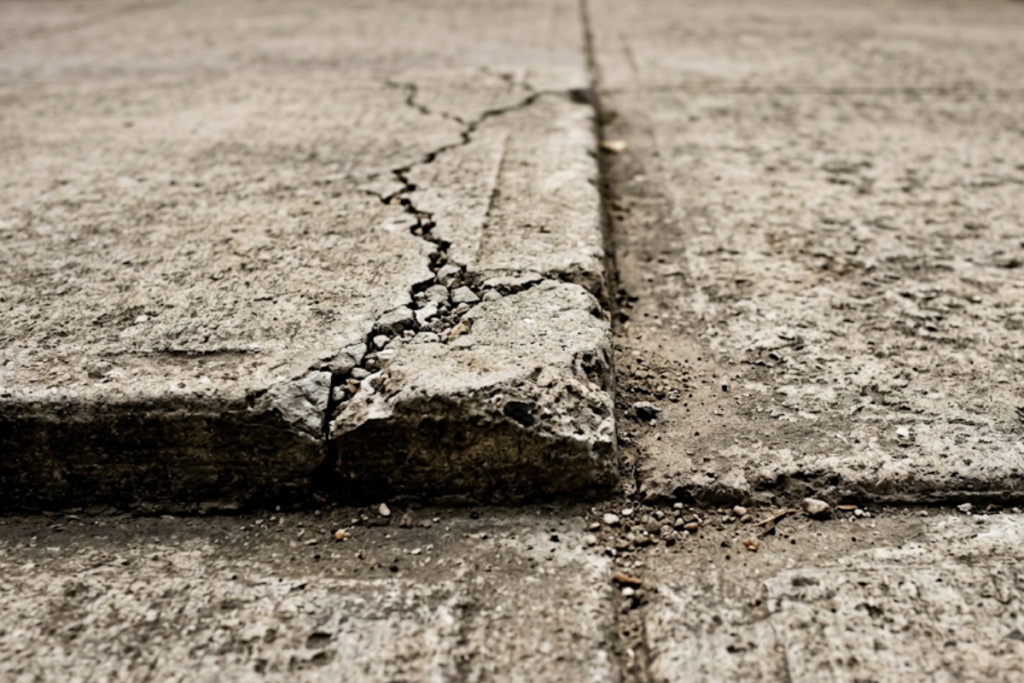
On Tulsa’s older sidewalks along stretches like Cherry Street and Brookside, decades of Oklahoma’s freeze-thaw winters and expansive clay soil have pushed concrete slabs up an inch or more at the seams, turning an ordinary walk into a real hazard. When a slab like that catches a shoe and someone goes down hard on the pavement, the first question is rarely about pain or medical bills. The real question is who is responsible if I trip on a broken sidewalk in Oklahoma, because the answer determines who pays for the emergency room visit, the missed work, and the recovery that follows. Unlike a fall inside a store, a sidewalk sits at the intersection of public property, private ownership, and city ordinance, and figuring out which one applies can take real digging.
That question does not have a single answer, and that is exactly what trips people up, literally and legally. Depending on where the defect is located, the responsible party could be the city of Tulsa, a homeowner, a business owner, or a homeowner’s association. Each comes with a different legal standard, a different insurance policy, and in some cases, a dramatically different deadline for filing a claim.
So, Who Is Responsible If I Trip on a Broken Sidewalk in Oklahoma?
Responsibility for a sidewalk defect generally comes down to two questions: who owns or controls the property where the defect exists, and did that party know, or should they have known, about the danger. This is the foundation of premises liability, the legal principle that requires property owners and occupiers to keep their property in a reasonably safe condition for people who are lawfully there (known legally as invitees). Oklahoma courts, like most states, look at whether the property owner had actual or constructive knowledge of a hazard and failed to fix it or warn about it within a reasonable time. An attorney evaluating liability after a sidewalk fall has to trace ownership records, city maintenance logs, and sometimes utility easements before ever getting to the question of compensation.
City-Owned Sidewalks vs. Private Property: Why the Distinction Matters
Most public sidewalks sit in a strip of land the city owns or holds as a right-of-way, but in many Oklahoma cities, including Tulsa, the day-to-day duty to repair the slab in front of a house or business is placed on the adjacent property owner by local ordinance, even though the land underneath technically belongs to the municipality. That split is common practice nationally; sidewalk maintenance guidelines documented by federal transportation researchers confirm that most communities delegate repair duties to the adjacent property owner rather than handling every defect through a public works crew. That does not mean the city is off the hook. If the city knew about a dangerous slab, perhaps from a prior complaint or a code inspection, and failed to act, it can still share or bear responsibility. This is one of the areas where sorting out liability matters most: the facts of ownership and notice, not assumptions, decide who pays.
Below is a general breakdown of how responsibility typically plays out by scenario. Every case is fact-specific, and this table is a starting point, not a legal conclusion.
| Sidewalk Scenario | Typically Responsible Party | General Basis for Responsibility |
|---|---|---|
| City-owned public sidewalk | City of Tulsa or relevant municipality | Government’s duty to maintain public rights-of-way, subject to the Oklahoma Governmental Tort Claims Act and its strict notice requirements |
| Sidewalk abutting a private residence | Adjacent homeowner | Local ordinance often assigns repair duty to the abutting property owner, paired with general premises liability standards |
| Sidewalk in front of a business | Business or commercial property owner | Premises liability duty owed to customers and other invitees to keep the property reasonably safe |
| HOA or common-area walkway | Homeowners association or property management company | Governing documents assign maintenance of shared walkways, creating a duty of care to residents and guests |
As the table shows, a city-owned public sidewalk generally falls to the municipality, though that claim runs through the Oklahoma Governmental Tort Claims Act rather than an ordinary insurance claim. A sidewalk abutting a private residence usually falls on the homeowner because local ordinance assigns the repair duty to the adjacent owner, layered on top of standard premises liability. A sidewalk in front of a business typically falls on the commercial property owner under the duty owed to customers and other invitees. An HOA or common-area walkway typically falls on the homeowners association or its management company because the governing documents make maintenance of shared spaces its responsibility.
Oklahoma’s Governmental Tort Claims Act: Special Rules When the City Is at Fault
If the sidewalk in question is public and owned by the city of Tulsa or another municipality, the claim does not work like a typical injury case. Oklahoma’s notice statute generally requires that a written notice of claim be presented to the proper clerk within one year of the date the loss occurs, and missing that window can bar the claim entirely, regardless of how strong the underlying case is. Tulsa’s own claim form spells out that a claim must be submitted to the City Clerk within that one-year window, along with details about the incident, injuries, and damages. This is one of the biggest traps for someone who assumes they have the standard two-year window that applies to most private injury claims in Oklahoma. Municipal notice deadlines are shorter, the procedure is more formal, and missing a technical requirement can end a valid claim before it starts.
Common Myths About Sidewalk Injury Claims
A lot of people assume that if they fell on public property, “the city will just take care of it,” or that a homeowner cannot be held responsible for a public sidewalk running along their yard. Neither assumption holds up consistently, and this is one of several misunderstandings that show up across personal injury cases generally, not just sidewalk falls; a broader look at common personal injury myths people still believe explains why assuming too much about fault or fees can cost real money. Another myth worth retiring: that a minor stumble with a bruise and some soreness is not worth documenting. Injuries from a hard fall on concrete, from wrist fractures to knee damage, often get worse or more expensive before they get better.
What to Do After a Sidewalk Trip and Fall in Tulsa
The steps taken right after a fall can shape how strong a claim ends up being, especially when notice deadlines are involved.
- Photograph the defect immediately, including a close-up with something for scale, such as a shoe or a coin, next to the crack or height difference.
- Get medical attention the same day if possible, even if the pain seems minor at first, since falls on concrete are a major source of fall injuries and emergency room visits nationally.
- Identify the exact location, including the nearest address, cross street, or landmark, since ownership can change block by block.
- Report the fall in writing to the property owner, business, or city as soon as possible, since some claims carry deadlines measured in months, not years.
- Keep receipts, medical records, and a timeline of missed work or limited activity from the start.
Why Choose Truskett Law After a Tulsa Sidewalk Fall
Sorting out who actually owes compensation after a sidewalk fall means untangling ownership records, city maintenance history, HOA covenants, and sometimes multiple insurance carriers pointing fingers at each other. That work looks different depending on whether the defect sits on a residential lot, a commercial strip, or a stretch of public right-of-way, and it changes again the moment a government entity is potentially involved, because that shifts the case onto a stricter timeline with formal notice requirements instead of the standard filing window. Truskett Law approaches sidewalk cases by identifying every party with a potential stake in the defect early, checking whether a municipal notice deadline applies before it quietly expires, and building the record, photos, ownership documents, and incident reports, that a fair settlement or a court case will eventually depend on. For Tulsa families dealing with a fracture, a torn ligament, or worse from a fall that should never have happened, that groundwork is what turns “who is responsible” from a frustrating question into an answer with a name attached.
Truskett Law offers a free case review for Tulsa sidewalk injury claims, and there is no fee unless the case wins, so getting the right answer costs nothing to start.
Final Thoughts on a Tulsa Sidewalk Injury Claim
A broken sidewalk case in Tulsa rarely resolves the way people expect, because the party at fault is not always obvious and the clock on a government claim can be far shorter than the two years most people assume they have. The most useful rule of thumb: document the defect and get medical care immediately, then find out who owns or controls that stretch of sidewalk before too much time passes, since that single fact determines which deadline applies. If a government entity might be responsible, treat the first few months as the critical window, not the first two years.
Contact Truskett Law for Your Free Case Review and let the firm sort out who is actually on the hook while the recovery gets the attention it deserves.
Frequently Asked Questions
Who is usually responsible if I trip on a broken sidewalk?
Responsibility depends on who owns or maintains that stretch of sidewalk. It could be the city, an adjacent homeowner, a business, or a homeowners association, so the answer requires checking ownership and maintenance records for that exact location.
Can I sue the city if I fell on a public sidewalk in Oklahoma?
Yes, but a claim against a city or government entity follows the Governmental Tort Claims Act, not a standard lawsuit. A written notice of claim generally must be filed with the proper government clerk within a set deadline before any lawsuit can proceed.
How long do I have to file a claim after a sidewalk fall in Oklahoma?
Standard Oklahoma injury claims have a longer statute of limitations, but claims involving a city or government entity require written notice within a much shorter window. Because these deadlines differ sharply, confirm which one applies as soon as possible after a fall.
Is a homeowner liable if someone falls on the sidewalk in front of their house?
It depends on local ordinance and the facts. In many cities, adjacent owners have some duty to maintain the sidewalk in front of their home, but the sidewalk may still be publicly owned, creating shared responsibility between owner and city.
What if a tree root or utility work caused the sidewalk defect?
The cause can point to a different responsible party, such as a utility company, contractor, or the city’s public works department, depending on who created or should have addressed the hazard. Identifying the cause is often key to determining liability.
